Families ACT Winter Update 2026
Dear Families ACT members and subscribers,
Welcome to the Winter 2026 update.
These past months have been a remarkable period of change and growth for Families ACT and the community.
Update: Child, Youth and Family Services Program — System Support Service
As announced in our Autumn update, Families ACT, in partnership with the Youth Coalition of the ACT, was awarded the ACT Government’s Child, Youth and Family Services Program (CYFSP) System Support Service grant. The Service will support: monitoring and evaluation, administration of the Sector Development Fund (previously the Workforce Development and Training Fund) and sector coordination and connection.
The System Support Service commences July 2026. Immediate priorities including developing the Hub’s Program Logic and early evaluation work and supporting the transition of Sector Development and Training fund. Families ACT and the Youth Coalition are working closely with HCSD during this establishment phase towards onboarding of CYFSP commissioned providers from 2027.
The Sector Development Fund will continue to operate as it currently does, overseen by the Workforce Development and Training Committee [further information about the WDT Committee available here] and guided by the CFYSP Workforce Capability and Learning Framework [Framework available here].
Child First Forum 2026 — reimagining our collective impact
On 12 and 13 May 2026, Families ACT hosted its second Child First Forum, bringing together representatives from across the community, education, health, research and government sectors. This year's Forum built on the momentum of 2025, which built a shared understanding of the challenges, enablers and priorities for collective action to address childhood vulnerability and poverty.
The 2026 Forum further focused on collective action: identifying concrete steps attendees could take together to improve coordination and supports for children, young people and families. The outcomes of this year’s Forum were informed by the research and advocacy of Professor Sharon Goldfeld, who shared her insights on the social and economic consequences of inequitable supports for children, the importance of early intervention, and the opportunities arising from collective and hub service models, including investment through the Thriving Kids initiative. Professor Goldfeld and Families ACT also presented at a private briefing with representatives from the ACT Legislative Assembly, generously hosted by Caitlin Tough MLA.
Key outcomes of the 2026 Forum include:
Forty-two participants attended the Forum representing service providers, researchers, government representatives, health and education representatives.
Participants identified seven priority actions to strengthen how services, communities and decision-makers work together to support children, young people and families across the ACT.
Established a Child First Collaborative to coordinate collective action, drive long-term improvements and keep children and families at the centre of decision-making.
Proposed working groups to focus on practical priorities, including developing a shared approach and language, improving how outcomes are measured, mapping existing services, exploring opportunities for co-location, strengthening the use of data and identifying future funding and advocacy opportunities.
Reinforced strong sector momentum, with 93 per cent of participants calling for more events like the Child First Forum and 85 per cent reporting they felt energised and hopeful about the work ahead.
Families ACT and partner organisations are now considering the Forum outcomes and next steps for supporting the actions of the Child First Collaborative, with further updates to be shared in the coming weeks.
In the meantime, we invite you to watch our short video capturing the energy, ideas and shared commitment that made this year's Child First Forum such a success.
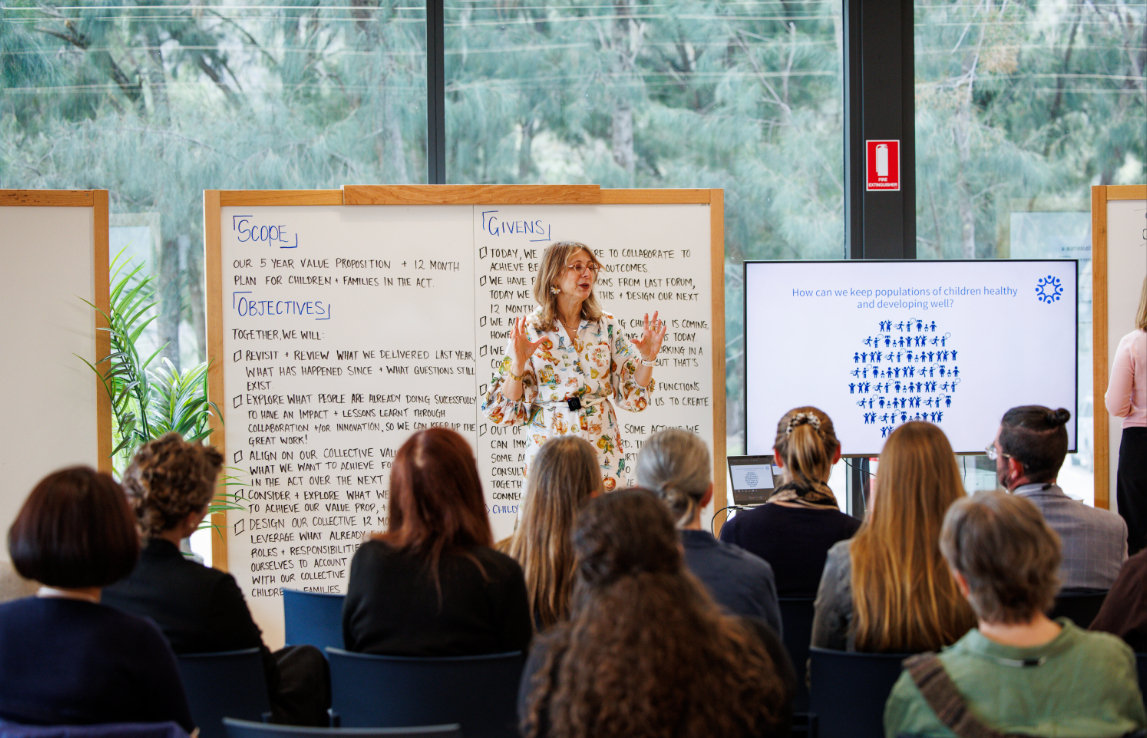
Professor Sharon Goldfeld, presenting to attendees of the Child First Forum.
ACT Budget 2026-27
On 10 June 2026, the ACT Government released its 2026-27 Budget. Key highlights relevant to the community sector include:
Community sector funding: A 26% increase in investment in the community sector, from $252 million in 2025-26 to $327 million in 2026-27 — an increase of $75 million, representing a rise from 2.6% to 3.3% of total budget expenditure. Additional funding of $23.7 million over four years has been allocated to community organisations [ACTCOSS analysis].
Housing and homelessness: $770 million allocated to new and expanded housing initiatives, with an additional $16.9 million invested in ACT homelessness services and continuation of the Housing Crisis Support Fund for rental assistance. With over $360 million to deliver an additional 450 public housing dwellings, growing the ACT’s public housing portfolio by 13,200 homes by the end of 2030.
Thriving Kids: $14.8 million allocated in 2026-27 for the design and implementation of Thriving Kids, a new initiative commencing 1 October 2026 to support children aged 0–8 with developmental delay and/or autism with low to moderate support needs. [note: this is the year one allocation; total investment over three years is approximately $17 million gross].
Aboriginal and Torres Strait Islander services: new initiatives of over $8 million to be delivered by ACCOs, building on the existing pipeline of funding to support programs delivered by the sector. New funding initiatives include: $1.2 million for a culturally informed perinatal mental health ‘Safe Space’ service; $1.9 million to boost Aboriginal and Torres Strait Islander health workforce; $500,000 to support Yerrabi Yurwang’s Housing Australia Future Fund application; and $1.8 million to strengthen oversight of justice system reforms.
Early Childhood Education and Care: The Budget provides $14 million to support quality early childhood education, with additional funding allocated to the extended Preschool Reform Agreement (free four-year-old preschool program), as well as funding to strengthen the regulation of Early Childhood Education and Care sector.
The community sector, including Families ACT, welcomes the additional investment announced in this budget, particularly the prioritisation of funding for housing and homelessness supports. This increase in funding reflects a coordinated effort across the community sector to advocate for increased government investment.
Child, youth and families specific budget outcomes
Funding for Children, Youth and Families in the 2026/27 budget (Outcome 3, HCSD) raises several concerns for Families ACT. These concerns include the ongoing prioritisation of funding to the statutory system, which accounts for 90% of the $240 million allocated to Children, Youth and Families programs. The remaining 10% is allocated to the Child and Family Centres and the Child Development Service.
While funding for statutory services continues to increase due to growing demand, early intervention funding within the Children, Youth and Families output has remained largely flat in nominal terms and is declining in real terms. This stagnant funding does not appear to reflect actual service demand, as most accountability indicators show that service use consistently exceeds budgeted targets, with the 2024-25 Annual Report noting that demand is increasing in part because families are presenting with greater complexity of need; an observation consistent with the experience of Families ACT's members.
As demonstrated through the Child First Forum, and through the work of Professor Sharon Goldfeld and other leading researchers, early intervention is central to addressing many of the inequities experienced by the most vulnerable children, young people and families. Evidence points to an overwhelming net benefit across the lifetime of individuals and families, as well as to the broader economy.
Families ACT recognises that reorienting funding to prioritise early intervention supports is a long-term process that will take time. However, there remains no overarching framework to guide and coordinate this transition, or to drive the cross-portfolio, whole-of-government accountability needed to achieve meaningful and sustained improvements for children and families in the ACT.
To highlight these concerns, Families ACT has provided a submission to the Select Committee on Estimates 2026-27, along with several questions raising some of Families ACT’s key concerns. This document is available here.
Joint Case Review update
On 19 May 2026, Families ACT delivered its final Joint Case Review (JCR) of the 2025–26 program series. Four JCRs were held across the year: September, November, March and May. Of these, two were general sessions and two were themed: one focused on disability co-hosted with ACT Down Syndrome & Intellectual Disability, and the second on housing and homelessness, co-hosted by St Vincent de Paul Society.
This JCR cycle saw:
67 attendees in total, across 39 organisations working with children, young people families across the ACT and NSW.
A pilot partnership with the ACT Child and Youth Mental Health Sector Alliance to support shared capability building and collaboration.
Participants reported increased confidence in reflective practice and collaboration.
Guest practitioners adding significant learning value, particularly in the specialist sessions on disability and on housing and homelessness.
Thank you to the dedicated and skilful facilitation of the JCR volunteer facilitators without which the JCR program would not be possible.
Families ACT looks forward to offering a new series of JCRs in 2026/27. Expressions of interest to become a JCR facilitator, together with new JCR dates, will open in September 2026.
Casework Reflective Tool update
In October 2025, the Casework Reflective Tool (CRT) Training was delivered by Families ACT to support practitioners working with children, young people and families to embed reflective practice into their everyday casework. Participants explore how to use the CRT as a tool for structuring case discussions, supporting supervision conversations, and inducting new staff.
Outcomes for participants included:
Improved understanding of reflective practice.
Increased confidence to apply the CRT to casework practice.
Reported peer learning and case study discussion as the most valuable aspects, supporting cross-organisational collaboration and a shared practice culture across the CYFSP.
The strong response to this training, together with growing demand for additional CRT opportunities, has enabled Families ACT to secure funding through the CYFSP Workforce Development and Training Fund to deliver further sessions in 2026–27.
Thank you to Elise Woodman for facilitating the 2026 CRT training and we look forward to continuing this work.
CRT training is currently planned for November 2026 and April 2027.
Become a Families ACT member
Families ACT membership continues to grow, with 40 organisations that support children and families from across Canberra now members. If your organisation would like to be part of this growing community and support the work of Families ACT, then please be in touch.
Thank you for making the time to read our Winter Update for 2026.
Please do not hesitate to contact Families ACT if you have any questions about the activities and updates outlined above.