Dear Families ACT members and subscribers
Welcome to Families ACT’s Spring 2026 update.
2025–26 Impact Report
Families ACT has completed its 2025–26 Impact Report, highlighting the breadth of advocacy, research, policy and sector development. This includes the second Child First Forum and Legislative Assembly briefing with Professor Sharon Goldfeld AM, and the establishment of the CYFSP System Support Service.
Importantly, annual stakeholder feedback included in the report provides a valuable measure of our progress and a clearer understanding of our stakeholders’ needs and priorities for the year ahead. Sector development needs identified included:
using data, evidence and reporting to improve services and demonstrate impact (69% of respondents),
collaboration and/or interagency work (63%),
developing culturally safe and inclusive practice (37%), and
child safety, safeguarding and risk management (37%).
Stakeholders also identified leadership priorities for Families ACT: building stronger coalitions for systemic change and promoting evidence-based early intervention for children and their families.
Thank you to all stakeholders who contributed their time and insights to help direct our priorities and activities in the year ahead.
You can read this year’s Impact Report [here].
Emerging drivers of declining AEDC results in the ACT
The ACT Government has released the Nous Group’s findings into the factors contributing to the declining Australian Early Development Census (AEDC) results in the ACT. The findings reflect many of the concerns and insights shared by the sector in recent years. The Nous Group proposed eight policy responses and potential initiatives, including:
provide support and educational initiatives targeting parents;
strengthen early identification;
improve system coordination and navigation functions;
develop the early childhood education and care (ECEC) workforce;
layer targeted, place-based interventions with universal system supports;
elevate Aboriginal and Torres Strait Islander community leadership; and
strengthen stewardship and joint accountability across government.
The findings and policy responses in the Nous report align with insights from the sector’s Child First Forum: strengthening service integration and stacking supports, alongside early intervention, is a key driver of system reform and is needed to ensure adequate, holistic supports are available for vulnerable children and their families. These activities must be enabled by rebalancing expenditure to adequately fund early intervention and service stacking to address systemic imbalances and align service coordination. On self-determination in early years design, it is vital that governments prioritise Aboriginal and Torres Strait Islander community-led service design and delivery, and remove barriers that hinder innovative, effective and grounded leadership efforts focused on children and their families.
With the next census due to take place in 2027 and the ACT Government’s newly announced Child Development and Wellbeing portfolio, Families ACT will continue to work with stakeholders to advocate for and explore best-practice initiatives to alleviate and reduce child developmental vulnerability in the ACT, specifically through the Child First Collaborative and the First 1000 Days Coalition.
You can access the full Nous Group report [here] and the summary report [here].
Ending the Cycle of Violence Conference
On 28 and 29 October, Families ACT’s communication, research and policy officer, Joshua Wrest, attended the Engaging Men & Boys to End the Cycle of Violence conference in Sydney, hosted by The Hatchery and supported by ANROWS, The Man Cave and Family Life.
Bringing together Australia’s leading researchers, frontline practitioners, survivor advocates and policymakers, this two-day conference explored the drivers of men’s use of violence, best-practice strategies to stop it and address the behaviour, and what the sector can do to evolve. Some of the key themes covered during the conference included:
fathers and men are often missing from services, with their absence meaning families and mothers carry the risk and the burden of keeping children safe;
children, including boys, are victims in their own right who often lack appropriate support, with boys often treated as future perpetrators;
accountability and care go together, recognising that the trauma experienced by perpetrators is context, but never an excuse;
the intersection between men’s mental health and men’s use of violence cannot be handled in separate silos;
relationships, attachment and fatherhood are powerful motivators for behavioural change; and
First Nations-led programs discussed during the conference had some of the strongest results, emphasising the importance of culturally safe, community-led practice.
This conference offered valuable insights into national and international discussions about ending child and family violence, and how best to support men and boys in our community. Families ACT will seek future opportunities to connect with experts from the conference, to explore what learning they can bring to the ACT for sector development and for policy, research and advocacy efforts.
CYFSP System Support Service
Since July, Families ACT and the Youth Coalition of the ACT have been setting up the CYFSP System Support Service (the CYFSP Impact Hub). The Child, Youth and Family Services Program (CYFSP) is the ACT Government program that funds community organisations to support children, young people and families. The Hub brings together evaluation, training and coordination so those services can work as a more connected system.
We are in the final stages of recruiting an Impact Hub Lead, who will be the sector’s dedicated day-to-day contact. A Project Officer will follow early next year. The Sector Development and Training Fund (formerly the Workforce Development and Training Fund) is now run by the Hub instead of government. Decisions on how the money is spent stay with the existing sector committee. Reflective Supervision training has been delivered, and a baseline survey to inform the Fund’s work is currently open to directors of CYFSP-funded services.
Over the next six months, we will bring sector perspectives into the Government’s framework for measuring how the program is working, before that framework is finalised. We will also introduce simpler ways to access training support and set out what the Hub aims to achieve and how we will measure progress. From early 2027, work begins on shared online tools to help providers connect and get set up.
Sector Development
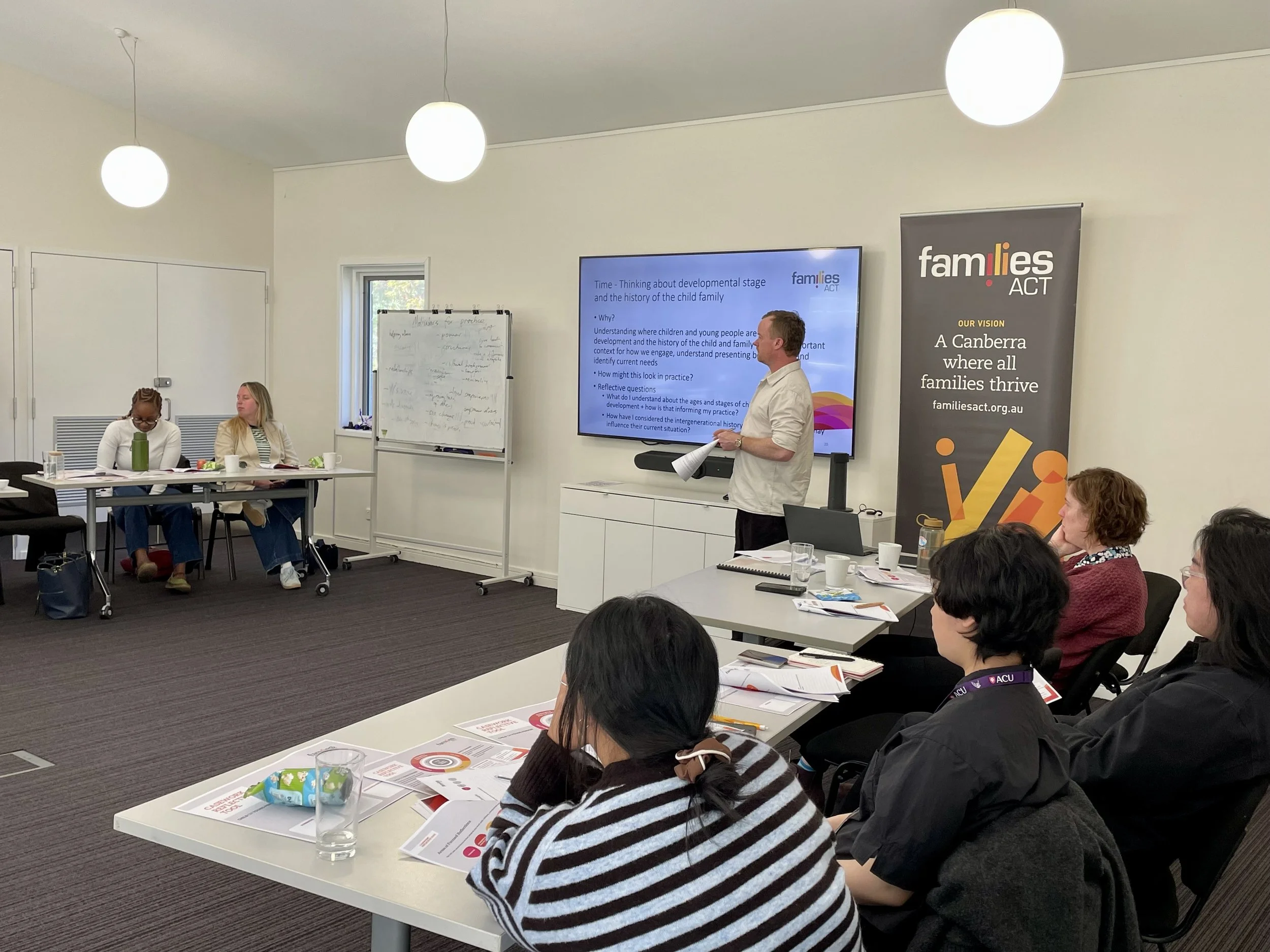
The final Joint Case Review (JCR) session for 2026 is on 17 November, co-hosted by Care Financial with a special focus on financial stress. This session is sold out, with a waitlist available should spaces become available [further details here]. This final workshop marks another successful year of Families ACT’s sector development activities, offering four JCRs and two sold-out Casework Reflective Tool trainings in 2026. More JCRs and other sector development trainings are planned for 2027. Further information about Families ACT’s sector development trainings will be shared via our newsletter and made available on our website.
Child First Collaborative’s Learning Network
In October, Families ACT commenced a series of workshops through its role leading the Child First Collaborative’s Learning Network. The first workshop, facilitated by Professor Sharon Bessell and Cadlha O'Sullivan from the ANU Children’s Policy Centre, explored the importance of children’s voices and the different dimensions of child poverty.
Participant feedback highlighted the value of deepening understanding in both areas. It also highlighted an opportunity to further explore what supports practitioners to translate new knowledge into practice.
Families ACT is continuing to work with Professor Bessell on what will be most useful to practitioners and the Collaborative in applying evidence into practice.
Workshops will continue in 2027, commencing with a session on Monday 22 February exploring the Australian Child and Youth Wellbeing Atlas and how data and evidence can inform the Collaborative’s work to better understand and respond to disadvantage, marginalisation and poverty affecting children and their families [registration available here]. This will be followed by information exchange sessions with other regional hub models, including Logan Together and First Steps Count (Taree), providing opportunities to learn from different approaches to place-based collaboration.
Further details, including registration information, will be shared through the Families ACT newsletter and website when available.
For more information on the Child First Collaborative is available [here].
First 1000 Days Conference — Hellenic Club, Woden, ACT
The 5th First 1000 Days Conference will be held at the Hellenic Club, Woden, on 25 November. This year’s theme is Strong Families, Strong Starts, and the full program is available [here]. Discounted tickets are available until 20 November.
Become a Families ACT member
If your organisation would like to be part of this growing community and support the work of Families ACT, then please be in touch.
Thank you for making the time to read our Spring Update for 2026.
Please do not hesitate to contact Families ACT if you have any questions about the activities and updates outlined above.